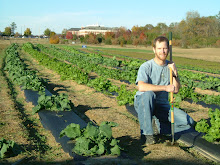
The Auburn community garden.
All produce goes to the local food bank.
This is my first blog by phone!
All produce goes to the local food bank.
This is my first blog by phone!
 This is my main field experiment in S. Tallassee, AL.
 It was killed without the use of herbicides using crimp-and-roll equipment, which is why all the rye is lying in the same direction.


 I have the earliest tomato blossoms in the area this year. I inherited 6 heirloom seedlings, planted in November, that were pot bound and P starved, but i resurrected them. I saw this week that they started blooming, so i decided now was a good time to put them in the ground.
 This is our longleaf pine, a native species to this area. Oddly, the daffodils have not bloomed yet... And i saw some blooming just down the road, too. I must've got defective bulbs.
 Here are the tomatoes I transplanted today. They don't look so tall here, but it's a good idea to prune off the lower leaves and plant the stem deep. The stems will then produce roots, giving them a stronger root system.
 I didn't want to put this photo in because there's nothing in it, but in the interest of completeness, i guess i have to show the bed pre-plant. I did put in 3 tomatoes, tho, but you can hardly see them yet.
 Well, winter killed a few of my landscaping plants, and if i don't replace them now, it'll be too late. The cold last night almost killed my tomato and pepper seedlings, and tonight it'll be just below freezing, so i had to move Alabama Days out of the bedroom to make room for our summer veggies-to-be. She'll understand come our first tomato harvest, i'm sure.