Sunday, February 15, 2009

600 Seedlings

Actually, only 544 in the flats above:
65 super sweet chen basil
135 opal (purple) basil
96 genovese basil
8 arugula
8 slicing tomatoes
8 king of the north bell peppers
8 cherry tomatoes
70 bolivian rainbow peppers
40 hidalgo chilis
50 sunrise orange bell peppers
40 italian flat leaf parsley


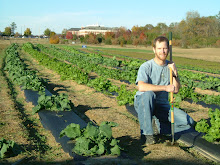
Me and my arugula, onions, and garlic.


A closer shot of my garlic patch.
I interseeded with Nantes coreless carrots today.


Onions, which i started from seed probably last September. They take forever.
These I also interseeded with carrots, Danvers 126.


Ever seen rosemary in bloom? It's bloomed the last couple of years, i have no idea why.


Seed saving from last year's Bolivian Rainbow peppers.
I left them on the plant all winter, so they went to seed.
I'll give the seed away or grow more transplants.


Thursday, February 12, 2009

Soil morphology

I'm teaching the lab portion for soil morphology this semester. Just got back from the field now.

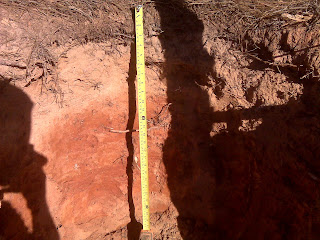
This is what we call a soil ped. "Ped" is a great scrabble word, btw.

We use peds to describe the soil structure using terms such as "subangular blocky", "granular", etc.

The ped above is weathered parent material, or saprolite, and can be found in the lower soil horizons, which in this case we would probably describe as a BC horizon.

When we go to the field to describe soils, we look at the soil profile. Sometimes the soil horizons are easy to pick out, most of the time they are not. They are difficult to see in this picture. But what you can see is the moisture deficit in the upper 10 inches of soil due to the last three years of drought and the well-drained nature of this soil.

Here are some students coloring a soil ped using a Munsell color chart.

Saturday, February 7, 2009

Maxed out on striper today

Went striper fishing with my major professor today. We just maxed out so now we're heading in for a cold one!
Sent via BlackBerry by AT&T

Winter harvest

We harvested 496 lbs of produce from the community garden the other day!
Sent via BlackBerry by AT&T

Monday, February 2, 2009

I've been referenced!

I was surprised to see my name referenced at the poster section during the conference I'm at. It's the first time I've been referenced to my knowledge!
Sent via BlackBerry by AT&T

Saturday, January 3, 2009

About to set sail

We're at the port now, about to embark on the MS Noordam.
Sent via BlackBerry by AT&T

Saturday, December 13, 2008

Last trip to the field!

Had to get back out into the field today, on a Saturday, to get a few photos of the organic matter accumulation in my fields again. Here's a shot of an armadillo "throw" which buried my organic matter with about two inches of soil.
Emma came with me too! She just can't resist pulling soil samples! Notice how the weeds are in rows, the same rows in which we grew collards. That's because we tilled those rows. Where we didn't till, there aren't weeds. This shows that no-till suppresses weeds, a major conclusion of this experiment.Just can't resist another photo of our organic matter accumulation after three years of no-till in a productive agricultural field in Alabama. Here we have a full inch of organic matter, which accumulated in 3 years!

Remember, it takes about 500 years to build an inch of soil under natural circumstances, but here we can obtain food while simultaneously improving soil quality. I will definitely be showing this slide at my next conference!